

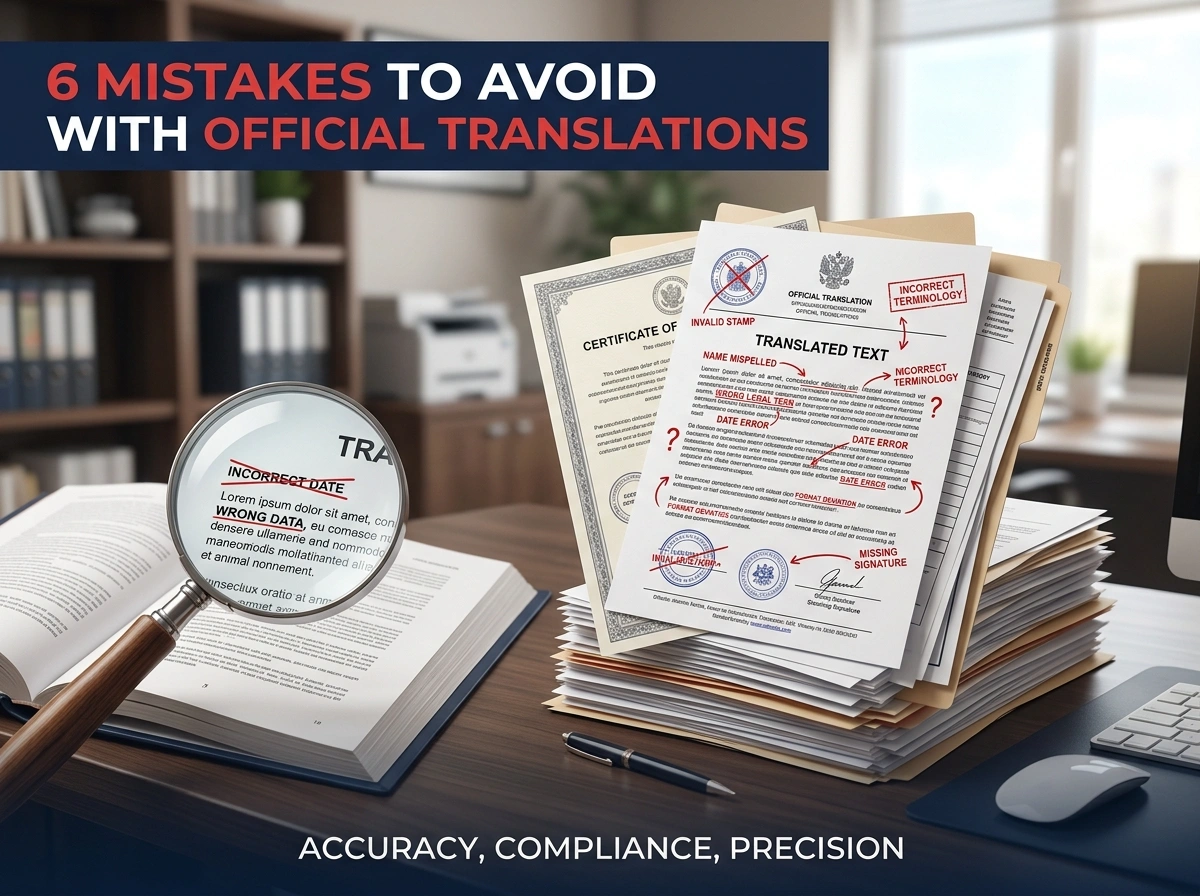
Submitting paperwork for a visa, court case, or university application is a high-stakes process. A single missing signature or formatting error can pause your progress for weeks. Foreign language documents add an entirely new layer of complexity to this process. Government agencies and institutions require exact, certified English versions of your original paperwork to move your case forward.
Failing to meet these strict documentation standards often leads to outright rejections. Immigration authorities like USCIS process thousands of applications daily, and they do not have the resources to decipher poor translations. The same applies to university admissions boards and legal clerks. They rely on certified professionals to bridge the language gap accurately and objectively.
Navigating the translation process might seem as simple as handing a document to a bilingual friend. The reality is far more rigid. Official institutions require a specific certification process that guarantees the accuracy of the translated text. Understanding these rules ahead of time will save you significant amounts of money and prevent highly stressful delays.
By recognizing the common pitfalls of the translation process, you can prepare your paperwork with confidence. Here are six frequent mistakes people make when requesting a certified translation, along with actionable advice on how to avoid them entirely.
Mistake 1: Not Understanding the Requirements of the Requesting Authority
Every institution has its own specific rulebook for accepting foreign documents. A translation that perfectly satisfies a university admissions office might be rejected by a federal immigration court. Assuming that one standard applies across all agencies is a frequent and costly error.
The United States Citizenship and Immigration Services (USCIS) is one of the most common destinations for translated documents. USCIS requires a certified translation, which means the document must be accompanied by a signed Certificate of Accuracy. The translator must explicitly state that they are competent to translate the language pair and that the resulting text is accurate and complete. If this specific certification statement is missing, the application will likely receive a Request for Evidence (RFE), delaying the entire immigration process.
State and federal courts often have even stricter guidelines. Depending on the jurisdiction, a judge might require the translator’s certification to be notarized. Some courts also mandate that the translator possess specific legal translation credentials. Similarly, the Department of Motor Vehicles (DMV) often has proprietary forms or specific certification requirements for translating foreign driver’s licenses and vehicle titles.
To avoid this mistake, you must read the exact submission guidelines provided by your requesting authority. Look for terms like “certified,” “notarized,” or “credentialed.” If the guidelines are vague, contact the institution directly and ask for their translation requirements before you hire a professional.
Mistake 2: Choosing an Unqualified Translator or Service
Because translation software has become incredibly advanced, many people assume they can use artificial intelligence to translate their official documents. Others attempt to save money by asking a bilingual family member to type up an English version of a birth certificate. Official government bodies uniformly reject both of these methods.
Institutions require an objective, qualified third party to perform the translation. A family member possesses an inherent conflict of interest. Machine translation, while useful for casual reading, lacks the legal accountability required for official proceedings. You must use a professional service that understands the legal phrasing, formatting, and certification standards of the United States government.
Selecting the right professional is equally important. When you request your official translation, verify that the provider has a strong track record of acceptance by organizations like USCIS. Look for companies that guarantee their work against agency rejection.
You should also check for professional affiliations. While the United States does not have a single federal licensing body for translators, membership in organizations like the American Translators Association (ATA) is a strong indicator of professionalism and ethical standards. Choosing a deeply experienced, highly rated service eliminates the risk of submitting a translation that looks unprofessional or contains critical linguistic errors.
Mistake 3: Providing Low-Quality Scans or Incomplete Documents
A translation can only be as accurate as the source material provided. Professional translators are language experts, but they cannot magically decode blurry, shadowed, or cut-off text. Providing a low-quality image of your document is a guaranteed way to stall your order.
Many people snap a quick photo of their marriage certificate on their phone and submit it for translation. If the lighting is poor or the camera is out of focus, critical details like dates, stamp text, and official signatures become illegible. The translator will be forced to insert “[illegible]” tags into the final document. When a government official reviews a translation filled with missing information, they will likely reject the submission.
Furthermore, applicants sometimes only photograph the front of a document, ignoring the stamps, seals, or legal text printed on the back. For a translation to be considered complete, every visible word on the original document must be translated. If an apostille or official seal is attached to the source document, that must be included in the translation as well.
Take the time to create a high-quality digital copy of your paperwork. Use a flatbed scanner if possible. If you must use a smartphone, use a dedicated document scanning application that flattens the image and increases the contrast. Ensure that all corners of the page are visible, the text is crisp, and you have included every page, front and back, of the document packet.
Mistake 4: Overlooking the Need for Notarization or Apostilles
Terminology matters immensely in the world of legal documents. People frequently confuse certified translations, notarized translations, and apostilles. Misunderstanding these terms can result in submitting the wrong type of authentication entirely.
A certified translation simply includes the signed Certificate of Accuracy from the translator or translation agency. For USCIS, this standard certification is usually sufficient. However, many people assume that “certified” and “notarized” mean the same thing. They do not.
A notarized translation takes the certification a step further. The translator must sign the Certificate of Accuracy in the physical or digital presence of a commissioned Notary Public. The notary then stamps and signs the document, authenticating the identity of the person signing the certificate. Local courts, banks, and some university boards specifically request notarized translations. If you submit a standard certified translation when a notarized one was requested, your paperwork will be sent back.
An apostille is a completely different authentication process. It is a specialized certificate issued by a government authority (like a Secretary of State) that authenticates a public document for use in another country under the Hague Convention. If you are submitting American documents to a foreign government, you will likely need an apostille. Sometimes, the translation itself needs an apostille. Always confirm authentication requirements with the receiving country’s consulate or embassy.
Mistake 5: Waiting Until the Last Minute
Legal and immigration processes are notoriously stressful. Compiling years of background information, financial records, and medical history takes a toll on applicants. As a result, the translation of foreign documents is often left as an afterthought, realized only days before a strict filing deadline.
Waiting until the eleventh hour creates unnecessary panic and heavily limits your options. Standard professional translation usually takes between one and three business days, depending on the length and complexity of the document. If you suddenly realize you need a 20-page financial statement translated and certified by tomorrow morning, you will face massive rush fees, assuming you can find a provider with the immediate capacity to help.
Rushing the process also increases the likelihood of human error. Translators are meticulous professionals who need time to research obscure institutional phrasing, decipher complex stamps, and format the English document to mirror the original perfectly. While reputable companies offer expedited services that maintain high quality, applying unnecessary time pressure is always a risk.
Audit your required documentation weeks or months before your submission deadline. Identify every foreign-language document immediately. By requesting your translations early in the process, you give yourself ample time to review the digital drafts, request any necessary spelling corrections, and receive physical copies in the mail if required by your institution.
Mistake 6: Failing to Verify Name Spellings and Key Data
Languages that use non-Latin alphabets, such as Arabic, Russian, Chinese, or Japanese, present a unique challenge during translation. When translating these languages into English, the translator must transliterate names and locations. Because there are often multiple valid ways to spell a transliterated name in English, inconsistencies frequently occur.
For example, a Russian name might be transliterated as “Aleksandr” by one translator and “Alexander” by another. If your translated birth certificate says “Aleksandr” but your passport and visa application say “Alexander,” an immigration officer might question your identity. Discrepancies in name spellings across official documents are a massive red flag for government agencies and will trigger delays and requests for clarification.
The same issue applies to dates and locations. Different countries format dates differently (e.g., Day/Month/Year vs. Month/Day/Year). While a professional translator knows how to handle these conversions accurately, it is ultimately your responsibility to check the final product before submitting it to the government.
When you place an order with a translation agency, proactively provide them with the exact English spellings of all proper nouns as they appear on your passport or current U.S. government documents. Once the translation is complete, thoroughly review the draft. Check every single name, date of birth, place of birth, and numerical figure against your original records.
How to Ensure a Smooth Official Translation Process
Avoiding the mistakes listed above requires a proactive and organized approach. By treating the translation step as a critical component of your legal filing rather than a minor administrative chore, you can navigate the system flawlessly.
First, create a comprehensive checklist based on the instructions provided by the agency reviewing your application. Note exactly which documents require translation and what level of certification they demand. Do they need standard certification, notarization, or physical copies mailed to you?
Next, digitize your documents with care. Clean the lens of your scanner or camera, ensure bright and even lighting, and verify that every word is highly legible before sending the files to a professional.
Finally, communicate clearly with your translation provider. Supply them with a glossary of preferred name spellings matching your official English identification. Review their work promptly upon delivery, and do not hesitate to ask for corrections if a date or name does not align with your other paperwork.
Moving Forward with Your Official Submissions
Securing accurate translations is an essential step toward achieving your immigration, academic, or professional goals. While the bureaucratic requirements can seem overwhelming, they exist to maintain the integrity of the legal system. Approaching this process with attention to detail ensures that your application is evaluated on its merits, rather than delayed by an administrative technicality.
Take inventory of your foreign documents today. Verify the exact certification rules of your requesting agency, prepare high-quality digital copies, and partner with an experienced, highly rated translation provider. With your paperwork properly translated and certified, you can finalize your application and move on to the next chapter of your journey.
