

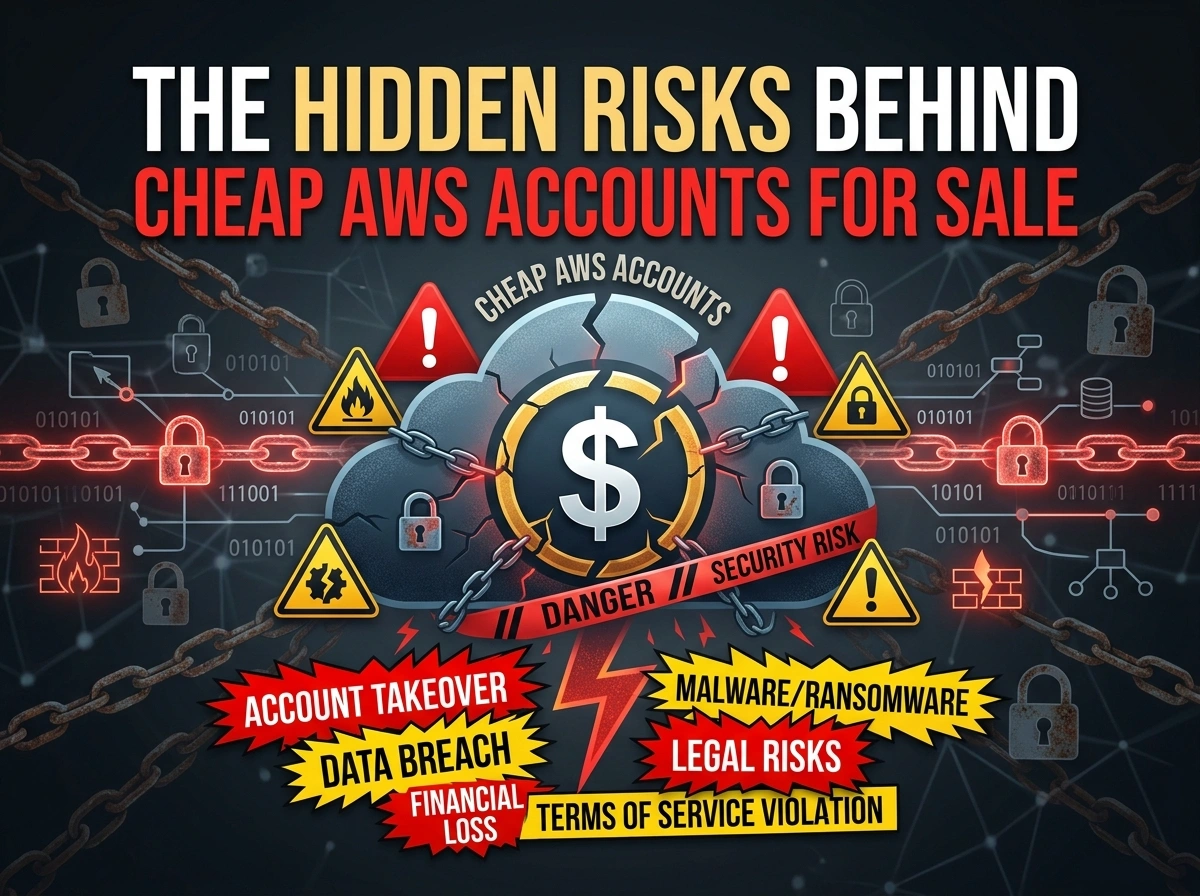
The promise sounds tempting. You spot an ad offering ready-made AWS accounts at a fraction of the usual cost, often with credits already loaded or verification steps skipped. For startups, developers, and budget-conscious businesses, the idea of grabbing instant cloud access for next to nothing feels like a smart shortcut. But that shortcut can lead straight into a minefield.
Cheap AWS accounts sold through unofficial channels carry far more baggage than most buyers realize. Behind the low price tag sit serious threats to your data, your finances, and even your legal standing. Before you hand over money for a deal that seems too good to pass up, it pays to understand exactly what you might be signing up for.
Why People Buy Cheap AWS Accounts
Amazon Web Services powers a huge slice of the internet. Companies use it for hosting, storage, machine learning, and countless other workloads. Setting up a legitimate account, however, can involve identity verification, billing checks, and usage limits for new users.
That friction pushes some people toward resellers. They want to skip the setup, dodge verification, or grab promotional credits without qualifying for them. Others simply want lower costs. While the motivation makes sense, the source of these accounts almost always raises red flags. Many are created with stolen identities, fake payment details, or automated bots that violate Amazon’s terms from the very first click.
Security Vulnerabilities You Can’t See
When you buy a pre-made account, you have no idea who built it or who still holds access. The seller may keep login credentials, recovery email access, or linked phone numbers. That means a stranger could quietly monitor your activity, copy your data, or lock you out whenever they choose.
These accounts often come with weak or shared passwords. Some have been passed through several hands before reaching you. Each previous owner is a potential backdoor. You might deploy sensitive applications believing the environment is private, only to discover it was compromised before you ever logged in.
Real cloud security depends on knowing your account’s full history. With a purchased account, that history is a black box. You inherit every flaw, every forgotten access key, and every hidden risk baked into it.
Account Suspension Can Happen Without Warning
Amazon actively hunts for accounts that break its rules. Buying, selling, or transferring AWS accounts violates the AWS Customer Agreement. When Amazon’s systems detect suspicious patterns, such as sudden ownership changes, mismatched billing data, or unusual login locations, they suspend the account fast.
Suspension is not a slap on the wrist. It can mean instant loss of every service you run. Websites go dark. Databases become unreachable. Applications that customers depend on simply vanish. Because the account was never legitimately yours, you have almost no path to appeal or recover it.
Imagine building your business on top of an account that disappears overnight. The money you “saved” suddenly looks tiny next to the cost of rebuilding everything from scratch.
Compliance and Legal Problems
Many industries operate under strict data rules. Healthcare, finance, and e-commerce all face regulations like HIPAA, PCI DSS, and GDPR. These frameworks require clear control over where data lives and who can touch it.
A purchased account undermines all of that. You can’t prove a clean chain of custody. You can’t guarantee the environment meets regulatory standards. If an auditor asks how you obtained your infrastructure, “I bought it from a reseller online” is not an answer that holds up.
Using accounts tied to fraudulent identities may also expose you to legal liability. You could be linked to identity theft, payment fraud, or terms-of-service violations you never intended to commit. Ignorance rarely protects you when investigators come knocking.
The Real Danger of Data Breaches
Data is the lifeblood of modern business. A single breach can destroy customer trust and trigger massive penalties. Cheap AWS accounts dramatically raise your breach risk.
Since you don’t control the account’s full access list, malicious actors may still hold keys to your environment. They could extract customer records, financial information, or proprietary code. Worse, they might inject malware or use your resources to attack other targets, all while your name sits on the account.
When a breach traces back to your infrastructure, you bear the consequences. Notification costs, lawsuits, and reputational damage pile up quickly. No discount on an account is worth that exposure.
Fraudulent Activity and Hidden Misuse
Accounts sold on shady marketplaces are frequently used as tools for fraud. Sellers may keep partial access to mine cryptocurrency, send spam, or launch attacks using your billing identity. You become an unwitting participant in activity you never approved.
This kind of misuse often goes undetected until the bill arrives or until Amazon flags the account. By then, the damage is done. Your reputation with cloud providers can be permanently stained, making it harder to open legitimate accounts in the future.
Financial Liabilities That Stack Up Fast
Cloud billing can spiral out of control even under normal conditions. With a compromised account, the danger multiplies. If someone spins up expensive resources, like high-powered compute instances for crypto mining, the charges land on the account you’re using.
Because the payment method may be fraudulent or unstable, Amazon could hold you responsible for unpaid balances. You might also lose any prepaid funds the moment the account is flagged. Chasing a refund from an anonymous reseller is nearly impossible. The seller disappears, and your money goes with them.
What looked like savings turns into a stack of unexpected costs, surprise bills, lost prepayments, and the expense of migrating to a clean setup.
The Smarter, Safer Alternative
The good news is that you don’t need risky shortcuts to access AWS affordably. Amazon offers a generous free tier, startup credits through programs like AWS Activate, and flexible pricing that scales with your needs. Setting up your own account takes a little time, but it gives you full ownership, clear billing, and genuine security.
If you do explore third-party options, choose providers transparently and cautiously. Some businesses search for legitimate AWS Accounts For Sale and resources to understand the market before deciding. Whatever path you take, prioritize transparency, verifiable ownership, and compliance over a quick bargain.
A clean account that you fully control protects your data, your customers, and your peace of mind. That foundation is worth far more than any temporary discount.
Conclusion
Cheap AWS accounts dangle an appealing offer, but the hidden costs run deep. Security gaps, sudden suspensions, compliance failures, data breaches, fraud, and runaway charges all lurk behind that low price. Each one can cause damage that dwarfs whatever you hoped to save.
Building on a foundation you don’t truly own is a gamble with your business at stake. Instead, invest in a legitimate account, take advantage of official credits and free tiers, and keep full control of your cloud environment. In the long run, doing it right is always cheaper than cleaning up after a deal that went wrong.
